
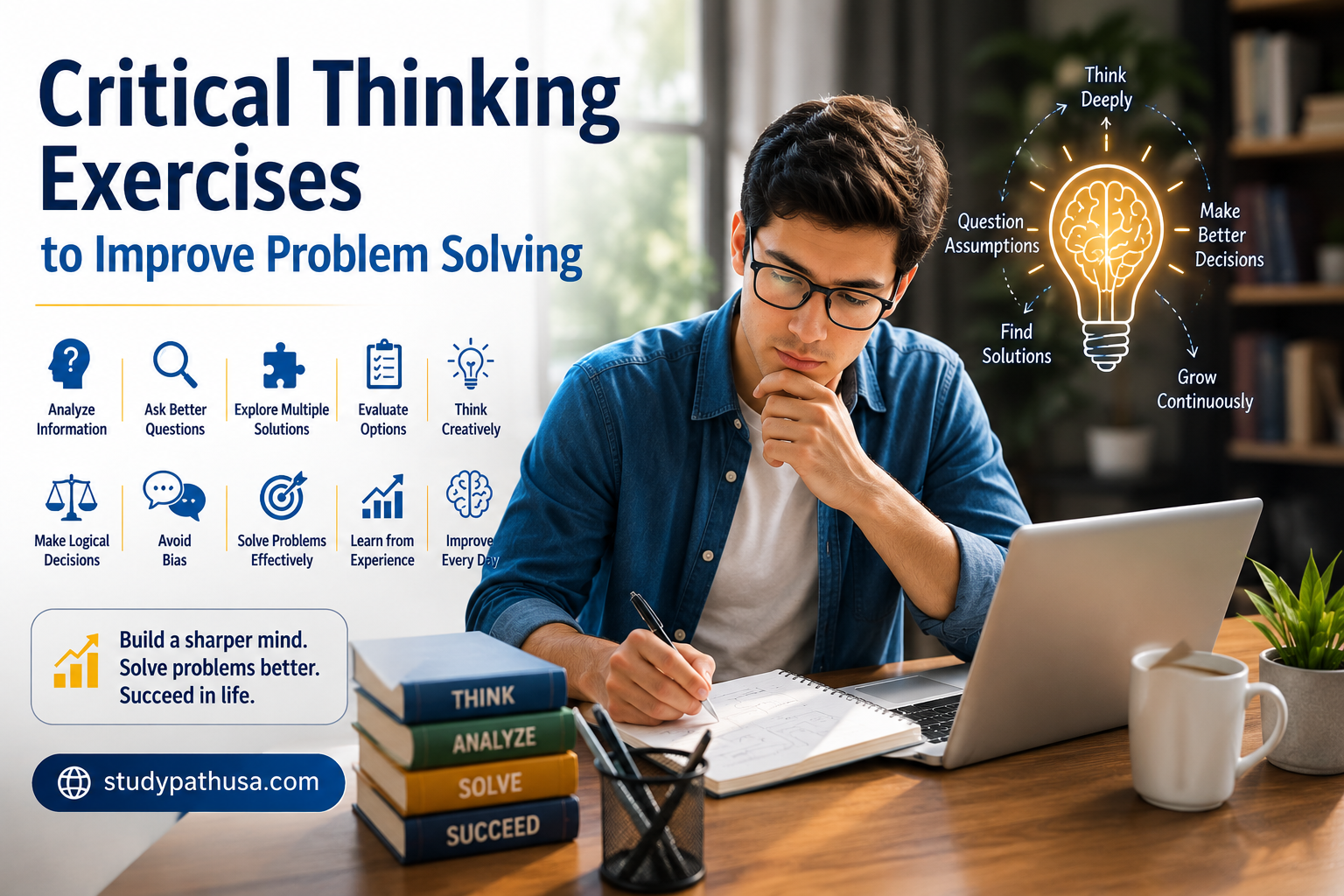
Critical thinking is one of the most useful skills you can learn.
It helps you solve problems.
It helps you make better decisions.
It also helps you understand information before you believe it.
Many people think critical thinking is difficult.
The truth is different.
Anyone can improve this skill with simple daily practice.
You do not need special training.
You only need the right exercises.
In this guide, you will learn simple critical-thinking exercises that anyone can practice.
These activities are simple.
They work for students, teachers, parents, and professionals.
If you practice a little every day, your mind will become stronger.
You will feel more confident when solving problems.
Table of Contents
- What Are Criticals Thinking Exercises?
- Why Critical Thinking Is Important
- Benefits of Critical Thinking
- Exercise 1: Ask “Why?”
- Exercise 2: Look at Both Sides
- Exercise 3: Solve Small Problems
- Exercise 4: Read and Ask Questions
- Exercise 5: Think Before You Decide
- Exercise 6: Compare Different Ideas
- Exercise 7: Find Missing Information
What Are Critical Thinkings Exercises?
Critical thinking exercises are simple activities that train your brain
They help you think carefully before making a decision.
Instead of accepting the first answer, you learn to ask questions.
You look for facts.
You compare ideas.
Then you choose the best solution.
This skill is useful every day.
You use it at school.
You use it at work.
You even use it at home.
The more you practice, the better your thinking becomes.
Why Is Critical Thinking Important?
Every day we read news.
We watch videos.
We scroll through social media.
Not everything we see is true.
Some information is correct.
Some information is misleading.
Critical thinking helps you tell the difference.
It teaches you to stop and think before believing something.
This skill also helps you solve problems faster.
It improves decision-making.
Many employers in the USA look for people with strong critical thinking skills because they can work independently and solve challenges with confidence.
Benefits of Critical Thinkings Exercises
Practicing these exercises every day gives many benefits.
Better Problem-Solving
You learn to understand problems before trying to solve them.
This helps you choose better solutions.
Smarter Decisions
Instead of guessing, you use facts.
This reduces mistakes.
Better Learning
Students understand lessons more easily.
They also remember information longer.
Improved Communication
Critical thinkers explain ideas clearly.
They also listen to other people with respect.
More Confidence
Good decisions build confidence.
You trust yourself more because your choices are based on careful thinking.

Exercise 1: Ask “Why?”
One of the easiest exercises is asking “Why?”
Keep asking until you find the real reason.
Example
Your homework is late.
Why?
Because you started too late.
Why?
Because you spent too much time on your phone.
Why?
Because you had no study schedule.
Now you know the real problem.
Instead of blaming yourself, you can create a better routine.
This simple exercise improves problem-solving skills.
Exercise 2: Look at Both Sides
Do not accept only one opinion.
Think about different ideas.
Example
Should students study online or in a classroom?
Classroom learning offers face-to-face support.
Both have advantages.
Compare both choices before making a decision.
This exercise teaches fair thinking.
It also helps you respect different opinions.
Exercise 3: Solve Small Daily Problems
Every day brings small challenges.
Use them as practice.
Example
Your phone battery dies quickly.
Think of several solutions.
- Lower screen brightness.
- Close unused apps.
- Replace the battery.
- Carry a power bank.
Now compare each solution.
Choose the best one.
This trains your brain to think step by step.
Exercise 4: Read and Ask Questions
Reading is helpful.
Thinking while reading is even better.
Whenever you read an article, ask yourself:
- What is the main idea?
- What facts support this idea?
- Do I agree?
- Is there another opinion?
These questions improve understanding.
They also help you remember information.
You can use this exercise while reading books, blogs, or news articles.

Exercise 5 Think Before You Decide
Many people make quick decisions.
Later, they regret them.
Instead, pause for one minute.
Ask yourself:
- What are my choices?
- What might happen?
- Which choice is the safest?
- Which choice helps me most?
This simple habit improves decision-making.
It also reduces mistakes.
Exercise 6 Compare Different Ideas
Comparing ideas helps you think clearly.
Imagine you want to buy a laptop.
Laptop A costs less.
Laptop B has better performance.
Which one should you choose?
Think about:
- Your budget.
- Your needs.
- Long-term value.
- Product quality.
Writing the pros and cons on paper can make your decision easier.
Exercise 7 Find Missing Information
Sometimes people tell only part of the story.
A critical thinker looks for what is missing.
Example
An advertisement says,
95% of customers recommend this product.
Ask questions like:
- How many people were surveyed?
- Who did the survey?
- Was it independent?
- What did the other 5% say?
Looking for missing facts helps you avoid false claims.
It also helps you make smarter choices.
Simple Daily Challenge
Choose one exercise from this guide.
Practice it today.
Spend only 10 to 15 minutes.
Repeat tomorrow.
Small daily practice creates big improvements over time.
Exercise 8 Think About the Results
Every choice has a result.
Before making a decision, stop and think.
Ask yourself:
- What will happen if I choose this?
- What could go wrong?
- Is there a better option?
Example
You have an important test tomorrow.
You can study tonight or watch TV for hours.
Watching TV may be fun now.
But studying can help you get better grades.
Thinking about the results helps you make smarter choices.
Exercise 9: Solve Brain Puzzles
Brain puzzles improve logical thinking.
They also help your brain stay active.
Try activities like:
- Sudoku
- Crossword puzzles
- Word searches
- Logic puzzles
- Riddles
Example
Riddle:
I have keys but no locks.
I have space but no rooms.
You can enter, but you cannot go inside.
Answer: A keyboard.
Solving puzzles every day improves your thinking skills.
Exercise 10 Learn From Your Mistakes
Everyone makes mistakes.
The important thing is to learn from them.
Ask yourself:
- What happened?
- Why did it happen?
- What can I do better next time?
For example,
If you forgot your homework,
think about why.
Maybe you did not write it down.
Next time, use a notebook or phone reminder.
Learning from mistakes helps you grow.
Exercise 11: Practice Active Listening
Good thinkers are also good listeners.
When someone is talking:
- Listen carefully.
- Do not interrupt.
- Ask questions.
- Think before answering.
Active listening helps you understand ideas better.
It also improves communication.
Exercise 12: Check the Facts
Never believe everything you read online.
Always check the facts.
Ask yourself:
- Is this website trustworthy?
- Who wrote the article?
- Is the information up to date?
- Are there reliable sources?
This habit protects you from false information.
Exercise 13 Learn Something New Every Week
Your brain becomes stronger when you keep learning.
Try one new activity every week.
Ideas include:
- Read a new book.
- Learn a new word.
- Watch an educational video.
- Take a free online course.
- Learn a simple life skill.
Learning keeps your mind active.
Exercise 14 Write a Thinking Journal
Writing helps organize your thoughts.
Every evening, write about your day.
Answer questions like:
- What did I learn today?
- What problem did I solve?
- What mistake did I make?
- What can I improve tomorrow?
A journal helps you see your progress.
Exercise 15 Think of More Than One Solution
Many people stop after finding one answer.
Try to find at least three solutions.
Example
Your laptop stops working before an assignment is due.
Possible solutions:
- Borrow another laptop.
- Use a library computer.
- Ask your teacher for extra time.
- Repair the laptop.
Comparing different solutions helps you make better decisions.
Daily Habits That Improve Critical Thinking
Small habits create big results.
Try these every day.
Read for 15 Minutes
Books and educational blogs improve knowledge.
Ask One Good Question
Be curious.
Questions help you learn.
Solve One Small Problem
Practice with everyday situations.
Think Before Speaking
Take a few seconds before answering.
Reflect Before Sleeping
Think about one lesson you learned today.
Common Mistakes to Avoid
Many people slow their learning by making these mistakes.
Believing Everything Online
Always verify information.
Making Fast Decisions
Take your time.
Ignoring Different Opinions
Listen to others with an open mind.
Letting Emotions Control Decisions
Use both facts and feelings.
Never Asking Questions
Curiosity is the key to learning.

Tips to Improve Critical Thinking Faster
- Read every day.
- Stay curious.
- Practice solving problems.
- Play strategy games.
- Learn from mistakes.
- Listen carefully.
- Ask questions often.
- Compare different ideas.
- Keep a journal.
- Practice a little every day.
Even 15 minutes daily can make a big difference.
Frequently Asked Questions
What are critical thinkings exercises?
They are activities that help you think clearly, solve problems, and make better decisions.
Can children practice critical thinking?
Yes.
Children can solve puzzles, read books, ask questions, and play strategy games.
How long should I practice?
About 10 to 20 minutes every day is enough.
Why is critical thinking important?
It improves learning, decision-making, communication, and problem-solving.
Which games help improve critical thinking?
Chess, Sudoku, crossword puzzles, escape room games, and logic puzzles are excellent choices.
Conclusion
Critical thinking is a skill that can improve every part of your life.
It helps you solve problems.
It helps you make better decisions.
It also helps you understand the world more clearly.
The best part is that anyone can learn it.
You do not need expensive tools or special classes.
Start with one simple exercise today.
Practice every day.
Ask questions.
Look for facts.
Think before making decisions.
Over time you will become more confident.
You will solve problems faster.
You will make smarter choices at school at work and in everyday life.
Improving your thinking is one of the best investments you can make.
Start today and enjoy the benefits for years to come.